UNITES STATES HISTORICAL FLAGS (2)
Date: August 8, 2026
US Historical Flag on Display:
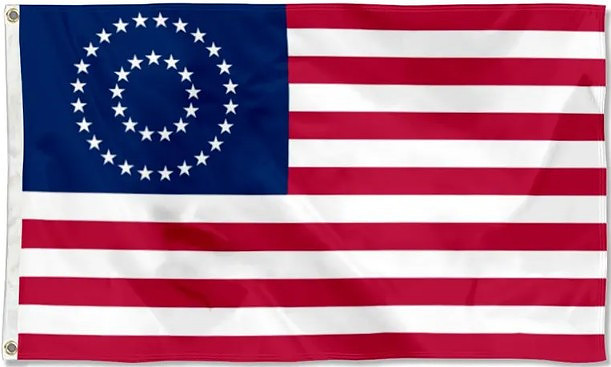
37 Star Medallion Flag

History of the Flag:
A 37-star medallion flag is an official U.S. banner used from 1867 to 1877 featuring a circular or oval "medallion" star arrangement. It marks Nebraska’s statehood to the Union on March 1, 1867, the Reconstruction era, and early centennial designs. The geometric ring layout symbolized unity and equality among states.
Served as the official national flag during the Reconstruction Era and early Indian Wars under Presidents Andrew Johnson, Ulysses S. Grant, and Rutherford B. Hayes.
The Medallion Design: Flag makers during this period frequently arranged stars in circular wreaths or rings rather than standard linear rows. Often, a large center star represented the newest state (Nebraska), surrounded by concentric rings of stars and corner accents.
Centennial Connection: Many medallion patterns from this era were crafted in anticipation of or as a tribute to the upcoming 1876 American Centennial, symbolizing a unified nation healing from the Civil War.
Source: CRW Flags / rareflags
Date: August 9, 2026
US Historical Flag on Display:
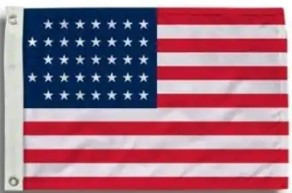
37 Star Flag
History of the Flag:
The 37-star U.S. flag became official on July 4, 1867, after Nebraska joined the Union on March 1, 1867. It lasted for 10 years until July 3, 1877, serving as the banner through the Reconstruction Era and the administrations of Andrew Johnson, Ulysses S. Grant, and Rutherford B. Hayes.
Most 37-star configurations featured a simple, multi-row grid pattern of 7-8-7-8-7 in the canton.
This flag waved during major milestones like the completion of the First Transcontinental Railroad (1869) and the ratification of the 15th Amendment (1870).
Most users on Reddit Vexillology (people who study flags, who knew?) agree that 19th-century star patterns prior to official rigid standardization often prioritized simple grid alignment for easier hand-stitching or manufacturing. Many consider this flag to be the most awful looking of the legal flags.
Per U.S. law, no historic flag ever becomes obsolete; the 37-star flag remains a legal national flag and can be flown at any time.
Source: americanflags / flagpoles etc. / reddit vexillology
Date: August 10, 2026
US Historical Flag on Display:
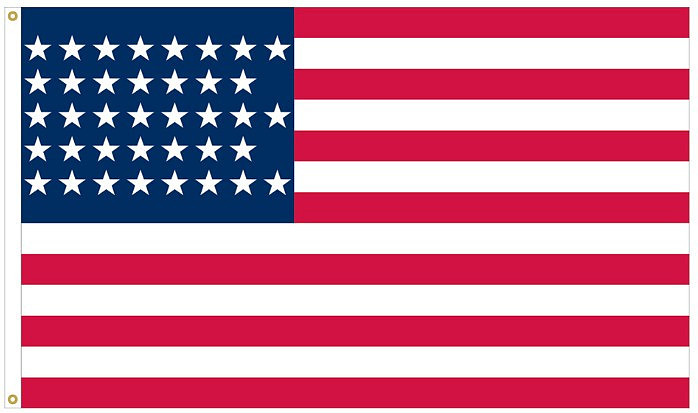
38 Star Flag
History of the Flag:
The U.S. 38-star flag became official on July 4, 1877, after Colorado joined the Union as the 38th state on August 1, 1876. Flown until July 3, 1890, this 13-stripe flag served for 13 years under five different U.S. presidents. Those were Rutherford B. Hayes, James A. Garfield, Chester A. Arthur, Grover Cleveland, and Benjamin Harrison.
Many makers produced 38-star flags early for the 1876 U.S. Centennial celebrations, even though the 37-star flag was still technically official at that time.
The federal government did not mandate a specific star pattern for the canton during this era.
Manufacturers created various star arrangements, including standard linear rows, geometric medallions, and "star of stars" configurations, which are not in this lineage of flags.
Per U.S. law, no historic flag ever becomes obsolete; the 38-star flag remains a legal national flag and can be flown at any time.
Source: Smithsonian / CRW flags
Date: August 11, 2026
US Historical Flag on Display:
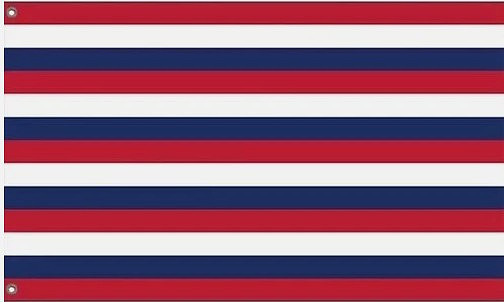
The Fort Mifflin Flag
History of the Flag:
The flag features 13 stripes that repeat in a strict sequence of red, white, and blue from top to bottom, ending on a red stripe. Notice it has no stars.
From October 4 to November 16, 1777, British forces unleashed the largest bombardment in North American history up to that point, firing more than 10,000 cannonballs at the small garrison. The massive flag was easily visible from Philadelphia, over seven miles away. During the intense shelling, the flag was shot down from its pole. Two soldiers were tragically killed by a British mortar shell while successfully raising it back up. Although the heavy damage eventually forced the Continental soldiers to evacuate to New Jersey, they never surrendered the fort. The flag was still defiantly flying on the morning of the evacuation.
Today, the flag represents the tenacity of the garrison whose weeks-long holdout delayed the British fleet and bought General George Washington critical time to safely move his army into winter quarters at Valley Forge. That Flag still flies over Fort Mifflin site today.
Source: Fort Mifflin on the Delaware
Date: August 12, 2026
US Historical Flag on Display:
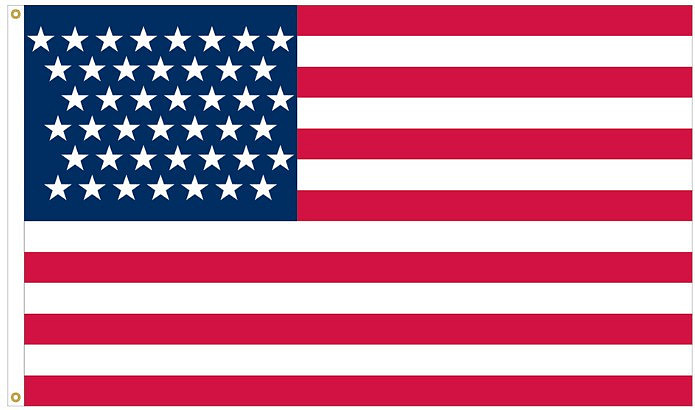
43 Star Flag
History of the Flag:
The 43-star U.S. flag officially represented the United States from July 4, 1890, to July 3, 1891. It marked the addition of Idaho as the 43rd state, on July 3, 1890 following a rapid wave of statehood admissions that also included North Dakota, South Dakota, Montana, and Washington. Because Wyoming became the 44th state just days later, this flag had a very short official window and remains one of the rarest 19th-century star counts.
The 43rd State: Signified Idaho's admission to the Union on July 3, 1890.
Rolled in stars for North Dakota, South Dakota, Montana, Washington, and Idaho all at once because they were admitted in rapid succession prior to the official July 4 update.
Wyoming became the 44th state just one week after Idaho on July 10, 1890.
The only U.S. President to serve under the 43-star American flag was Benjamin Harrison, whose term ran from 1889 to 1893
Flag makers and the public knew the 43-star layout would soon be obsolete, so manufacturers quickly stopped producing it in favor of anticipating the 44-star version.
Because so few were manufactured or sold, original 43-star antique flags are exceptionally scarce today
The 43-star flag remains a legal national flag and can be flown at any time.
Source: Idaho national guard
Date: August 13, 2026
US Historical Flag on Display:
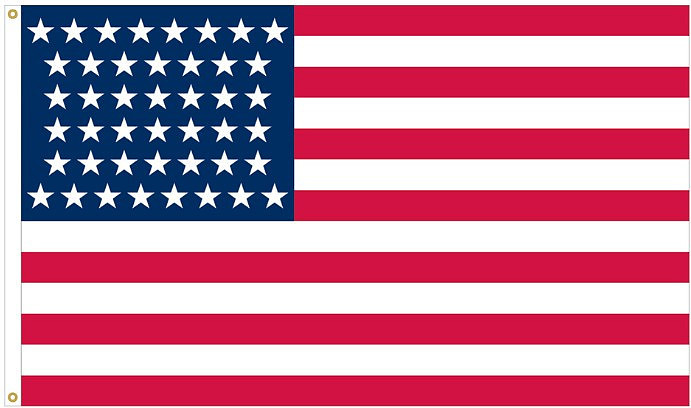
44 Star Flag
History of the Flag:
The 44-star U.S. flag officially became the American flag on July 4, 1891. It added a 44th star to represent the admission of Wyoming to the Union on July 10, 1890. This flag stayed active for five years until July 3, 1896.
Benjamin Harrison and Grover Cleveland were presidents under this banner.
The federal government still did not mandate a specific arrangement for the stars on the blue canton at this time.
Makers produced various star patterns, including staggered rows (such as 8-7-7-7-7-8) or circular medallion layouts.
The 44-star flag remains a legal national flag and can be flown at any time.
Source: CRW Flags
Date: August 14, 2026
US Historical Flag on Display:
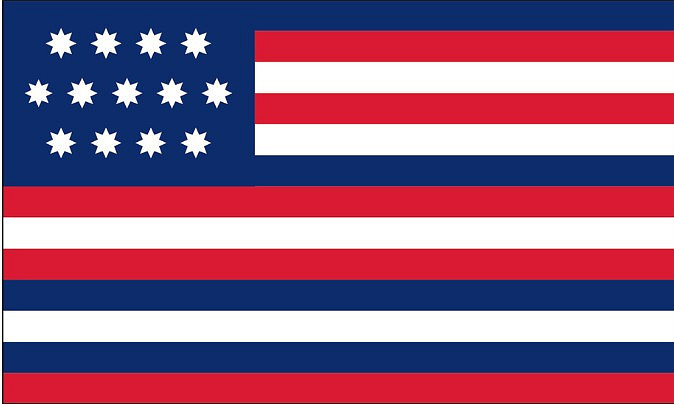
The Serapis Flag
History of the Flag:
During a legendary 1779 naval battle, Jones’s ship (the Bonhomme Richard) sank after he successfully captured the British frigate HMS Serapis. Because his own ship's ensign had been destroyed, Jones sailed the captured British vessel to the neutral Dutch port of Texel. British officials attempted to have him hanged as a pirate because he was not flying a recognized national flag
To bypass this diplomatic crisis, Dutch port authorities searched their records and found a sketch of an American flag previously described by Benjamin Franklin. Jones flew this flag, and it has since been known as the Serapis flag (or the Franklin Flag).
The Stripes: Unlike the standard American flag (which uses alternating red and white stripes), the Serapis flag features 13 stripes alternating in a tri-color pattern: red, white, and blue. The blue canton contains 13 stars. These stars are unique because they have 8 points rather than the 5 points typically seen on today's flags.
Because it predates the official 1777 Congressional Flag Act, it is not an official U.S. flag but is celebrated as an important early naval emblem of American independence. Today, the U.S. Army's 111th Infantry Regiment still maintains the Serapis flag as their official regimental flag
Source: Wikipedia
Date: August 15, 2026
US Historical Flag on Display:
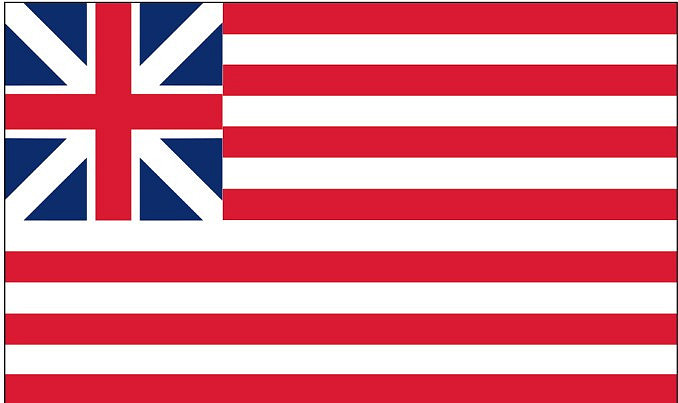
The Grand Union Flag
History of the Flag:
This flag was known by a number of names Continental Colors, Congress Flag, First Navy Ensign, and Cambridge Flag. Thirteen alternating horizontal stripes (7 red and 6 white) representing the original 13 colonies, with the British Union Flag in the upper left corner.
It was first flown on December 3, 1775, by Lieutenant John Paul Jones aboard the Continental Navy flagship USS Alfred in the Delaware River.
This flag was raised by George Washington on January 1, 1776, at Prospect Hill in Somerville, Massachusetts, marking the formation of the Continental Army.
The flag was effectively retired after June 14, 1777, when the Continental Congress officially adopted the 13-star Stars and Stripes.
Source: Wikipedia
Date: August 16, 2026
US Historical Flag on Display:
45 Star Flag
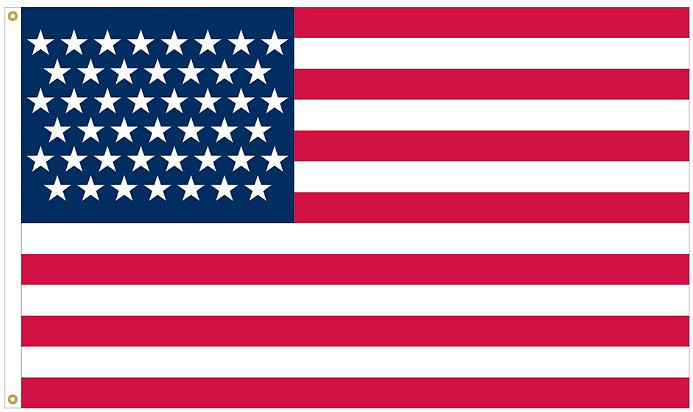
History of the Flag:
The 45-star U.S. flag officially represented the United States from July 4, 1896, to July 3, 1908 or a period of 12 years. The 45th star was added to honor the admission of Utah as the 45th U.S. state on January 4, 1896.
Presidents who served under this flag were Grover Cleveland, William McKinley, and Theodore Roosevelt.
This flag was carried into battle during the Spanish-American War
During the Spanish-American War, Theodore Roosevelt and the 1st U.S. Volunteer Cavalry, known as the Rough Riders, fought two primary land engagements in Cuba, the most remembered is the battle of San Jaun Hill.
The defining action of the war occurred when the Rough Riders, supported heavily by African American regular troops of the 10th Cavalry (Buffalo Soldiers), were ordered to take the lower adjacent summit known as Kettle Hill.
Lt. Col. Theodore Roosevelt galloped and then charged up the slope on foot (mounted on his horse Texas for a portion of the advance), rallying scattered troops and leading a chaotic, courageous rush that overran Spanish trenches.
After securing Kettle Hill, Roosevelt led a small group forward and joined the broader assault on the main San Juan Ridge, helping lock in the high ground that doomed the Spanish defense of Santiago.
On December 17, 1903, two brothers Orville and Wilbur Wright from Dayton, Ohio made the first controlled, sustained flights of a powered, heavier-than-air aircraft. Their plane, the 1903 Wright Flyer, took off near Kitty Hawk, North Carolina, with the first brief flight lasting 12 seconds and covering 120 feet.
Additionally resulted certain commemorative variants of this flag were produced in 1898 with the phrase "Remember the Maine" printed on the stripes of the flag as a patriotic tribute following the sinking of the USS Maine in Havana Harbor.
The 45-star flag remains a legal national flag and can be flown at any time.
Source: Smithsonian / pritzkermilitary / pbslearningmedia. / wikipedia
Date: August 17, 2026
US Historical Flag on Display:
46 Star Flag
History of the Flag:
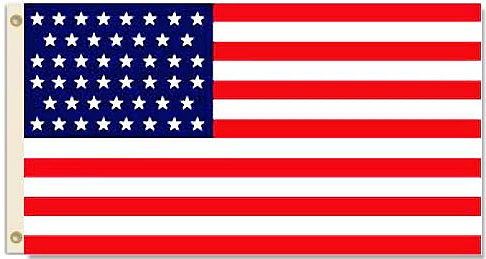
The 46-star U.S. flag officially represented the United States from July 4, 1908, to July 3, 1912. It gained its 46th star to honor the admission of Oklahoma as the 46th U.S. state on November 16, 1907.
Valid for just four years under Presidents Theodore Roosevelt and William Howard Taft.
The U.S. government did not officially regulate the exact star arrangement on the blue canton at this time, so manufacturers used various lineal or staggered patterns.
Between 1907 and 1912, the world experienced major technological milestones, and political changes.
Key events included the debut of the Ford Model T in 1908, and the tragic sinking of the RMS Titanic in 1912.
American explorer Robert Peary reached the North Pole in 1909.
Norwegian explorer Roald Amundsen became the first person to reach the South Pole in 1911.
The ocean liner RMS Titanic struck an iceberg and sank on April 15, 1912 killing over 1,500 people.
Source: Smithsonian / Wikipedia.
Date: August 18, 2026
US Historical Flag on Display:
The Continental New England Flag
History of the Flag:
During the American Revolution, multiple variations of the New England flag emerged as battle and maritime standards:
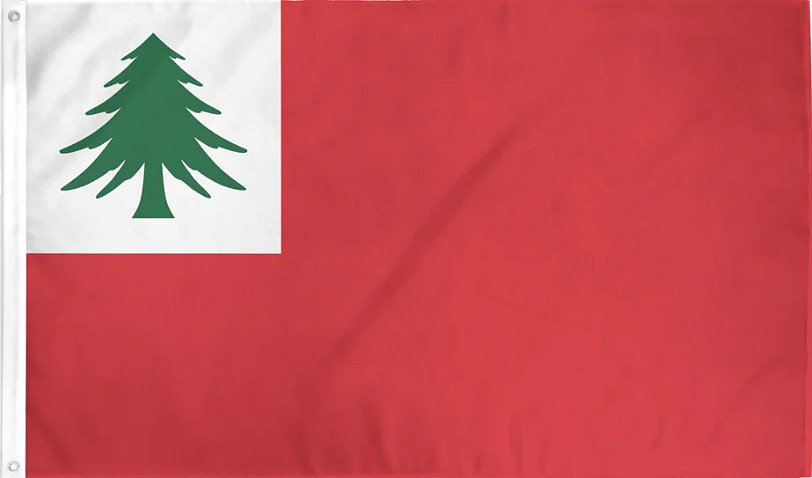
The Continental Flag: This design featured a solid red field and a white canton containing only the green pine tree, entirely removing the St. George’s Cross to signal an explicit break from British rule.
The Bunker Hill Flag: Often depicted as having a blue field with the St. George's Cross and a pine tree in the canton. While historians debate exactly which banners flew at the Battle of Bunker Hill on June 17, 1775, the blue variation became permanently cemented in American history as the "Bunker Hill Flag".
Source: National Park Service / Vexillology Wiki!
Date: August 19, 2026
US Historical Flag on Display:
The Bunker Hill Flag
History of the Flag:
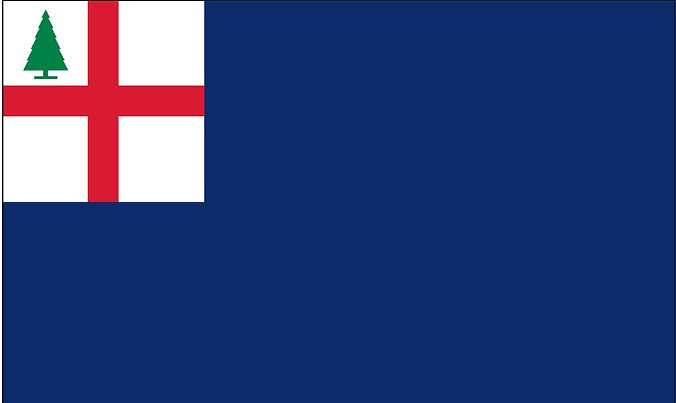
The Bunker Hill Flag: Often depicted as having a blue field with the St. George's Cross and a pine tree in the canton. While historians debate exactly which banners flew at the Battle of Bunker Hill on June 17, 1775, the blue variation became permanently cemented in American history as the "Bunker Hill Flag".
During the American Revolution, multiple variations of the New England flag emerged as battle and maritime standards: The pine tree symbolizes the region's independent economy and defiance, while the Cross of St. George nods to traditional English roots before the formal Declaration of Independence
Source: National Park Service / Vexillology Wiki!
Date: August 20, 2026
US Historical Flag on Display:
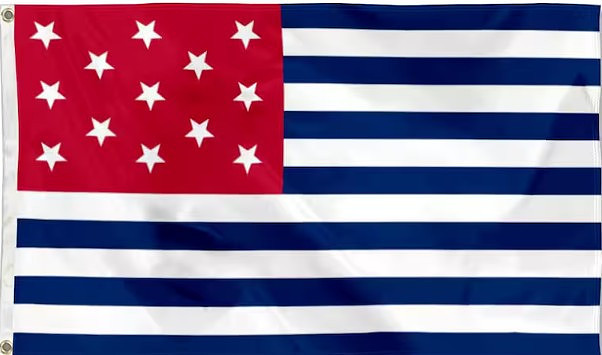
The Fort Mercer Flag
History of the Flag:
The Fort Mercer Flag is a historical American flag flown in 1777 at Fort Mercer in New Jersey during the American Revolution. It is famous because its colors are backwards. Instead of the standard red and white stripes, it has blue and white stripes. It also features a red canton (the top left box) filled with white stars. The original flag was made before the design of the American flag became an official standard.
Source: abouthisflag.us
Date: August 21, 2026
US Historical Flag on Display:
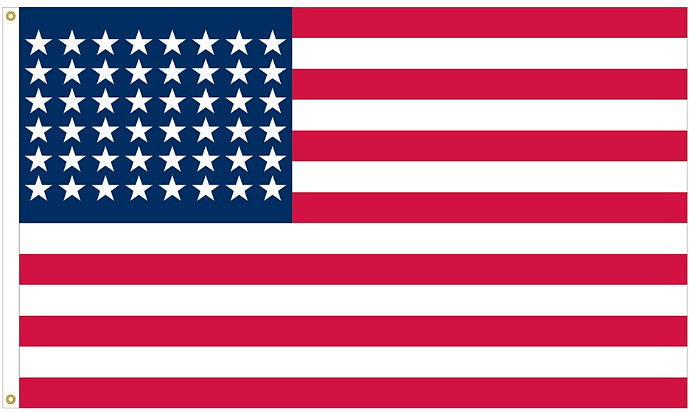
48 Star Flag
History of the Flag:
The 48-star American flag was the official U.S. flag from July 4, 1912, to July 3, 1959. It means the nation had 48 states, following the admission of New Mexico on January 6, 1912 and Arizona on February 14, 1912. It is famous as the flag carried through World War I “the war to end all wars”, World War II, and the Korean War.
History and Timeline
It became official on July 4, 1912, after New Mexico and Arizona joined the Union as the 47th and 48th states.
A total of eight U.S. presidents served under this 47-year-long flag era:
William H. Taft (1909–1913) — Ordered the official 6-row by 8-star layout.
Woodrow Wilson (1913–1921)
Warren G. Harding (1921–1923)
Calvin Coolidge (1923–1929)
Herbert Hoover (1929–1933)
Franklin D. Roosevelt (1933–1945)
Harry S. Truman (1945–1953)
Dwight D. Eisenhower (1953–1961)
Taft's 1912 executive order was the first time an American flag required a precise, uniform star arrangement rather than letting makers choose circular or messy offset patterns.]
Often called the "Flag of Liberation," it is the flag American troops fought under during World War II, during famous battles in which the “Greatest Generation” participated such as D-Day, the Battle of the Bulge, Guadalcanal, Midway and the raising of the flag on Iwo Jima. It was this flag that liberated the survivors of the Nazi death camps.
It is the flag families looked at during the Great Depression, the Pearl Harbor attack, and the mid-20th century. The 48-star banner is frequently remembered as the ultimate emblem of American resilience and global leadership.
It was this Flag that Jesse Owens won 4 Gold medals in the 1936 Olympics in Germany, thereby embarrassing the Nazi Government.
It was used for 47 years, making it the second longest-used U.S. flag design behind the current 50-star flag.
Source: national park service / americanflags
Date: August 22, 2026
US Historical Flag on Display:
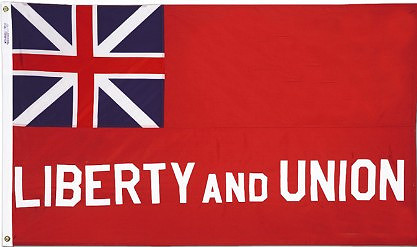
The Taunton Flag
History of the Flag:
The Taunton Flag (also known as the Liberty and Union Flag) was one of the very first rebellion banners raised in the Thirteen Colonies to protest British oppression prior to the American Revolution. First unfurled on October 21, 1774, in Taunton, Massachusetts, orchestrated by local Patriots and the Sons of Liberty under the guidance of Reverend Caleb Barnum, citizens raised a massive 112-foot liberty pole outside the Taunton Courthouse.
The protest was fueled by local outrage over the closure of Boston Harbor and mounting parliamentary oppression.
The event gained widespread colonial notoriety after being detailed in the Boston Evening-Post on October 24, 1774.
The Red Field: Echoed the traditional British Red Ensign, signifying colonial maritime ties and identity.
The Union Jack: Represented connection to Great Britain and allegiance to the concept of constitutional rights under the Crown.
"Liberty and Union": The added text served as a bold declaration that American subjects were bound together to protect their fundamental liberties as Englishmen, capturing a pivotal transition point where colonists demanded systemic change while still negotiating within the imperial framework.
Today, the design serves as the official city flag of Taunton, Massachusetts
Source: Wikipedia / federal flags
Date: August 23, 2026
US Historical Flag on Display:
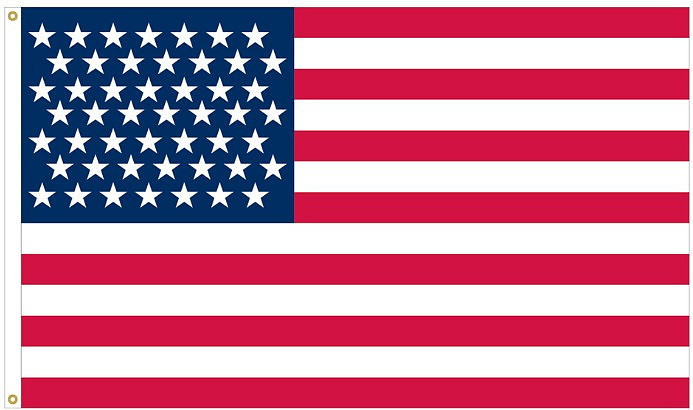
49 Star Flag
History of the Flag:
The 49-star U.S. flag was official for exactly one year, from July 4, 1959, to July 3, 1960. It honored Alaska’s admission as the 49th state on January 3, 1959. The star field features seven staggered rows of seven stars.
The 49-star U.S. flag was associated with only one president: Dwight D. Eisenhower, who was in office when it became official on July 4, 1959.
The U.S. successfully launched the Pioneer 4 space probe past the Moon in March 1959.
Ruby Bridges became the first African American child to integrate William Frantz Elementary School in New Orleans on November 14, 1960.
Mattel introduced the first Barbie doll at the American International Toy Fair in New York on March 9, 1959.
Source: Smithsonian / history.com
In a future blog I will share info for 40 Star, 41 Star and 42 Star Flags. It is an interesting story.
&layout=none&ref=https://www.danieljhancock.com/blog/2026/8/unites-states-historical-flags-2)